
Hunting Together RPG Classes: All 8 Jobs and Their Roles
Hunting Together RPG's eight classes span six base jobs and two Special Jobs. Here is what each one is built to do in a fight, in a party or as support.
Hunting Together RPG has eight classes: Swordsman, Mage, Archer, Thief, Cleric, Merchant, Samurai and Alchemist. The official game page counts them as "8 classes" that players master. In the game's Change Job window they are split into two groups: Swordsman, Thief, Archer, Mage, Cleric and Merchant are the base jobs, while Alchemist and Samurai sit in a separate Special Jobs column.
That split is the first thing to know when you are asking what each class is for, because the six base jobs are the ones with a described combat or support role. The table below is the quick lookup, listing the six base jobs first and then the two Special Jobs; the sections after it explain how each role behaves in play.
Hunting Together RPG classes and their roles
- Class
- Swordsman
- What it is built to do
- Melee tank with high HP and high defense; the frontline pick for boss hunts
- Class
- Thief
- What it is built to do
- Fast melee with rapid burst damage and high criticals, on a low health pool
- Class
- Archer
- What it is built to do
- Long-range bow with sustained single-target damage, plus some group attacks and control
- Class
- Mage
- What it is built to do
- Long-range caster with fire, ice and lightning area damage and control
- Class
- Cleric
- What it is built to do
- Heal and support: buffs allies, heals and revives fallen teammates
- Class
- Merchant
- What it is built to do
- Balanced melee with ground smash attacks, Gold bonuses and buying and selling advantages
- Class
- Samurai
- What it is built to do
- Newer class added as a Special Job; no specific fight role is described with the base jobs
- Class
- Alchemist
- What it is built to do
- Newer class added as a Special Job; no specific fight role is described with the base jobs
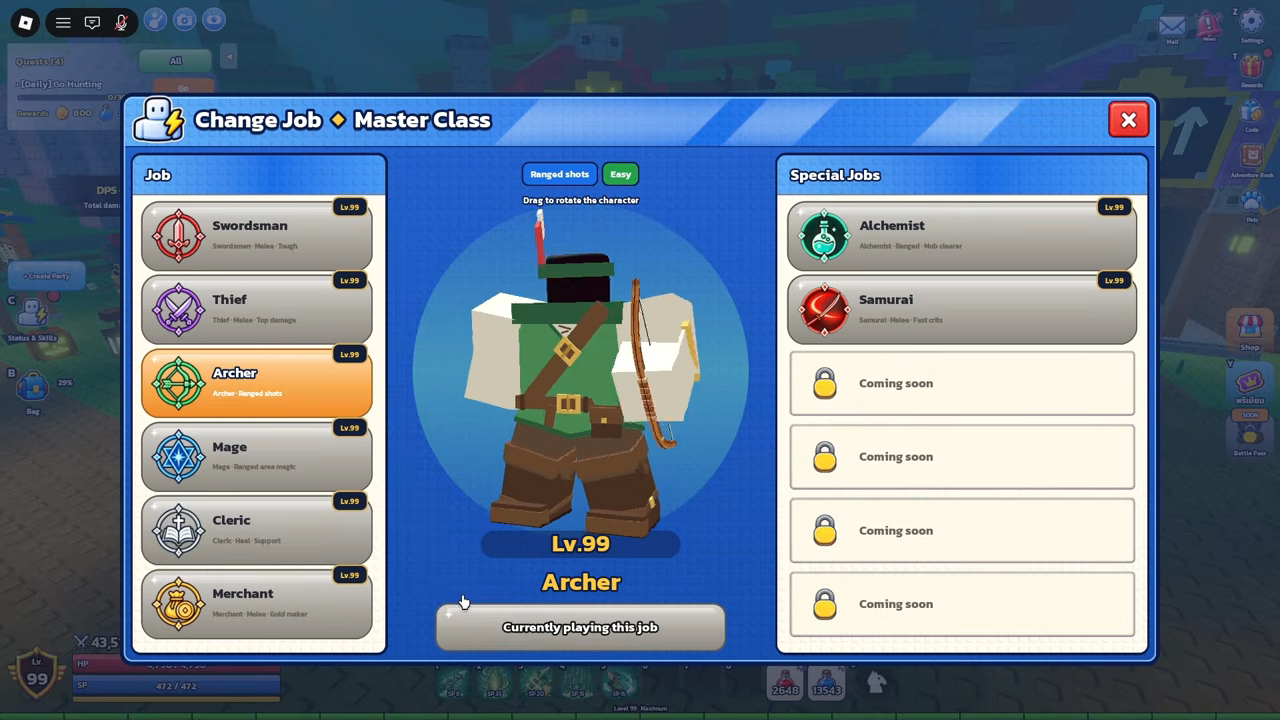
The six base jobs and what each one is for
Swordsman: the frontline tank
Swordsman is the melee tank. It fights with a one-handed sword and leans on high HP and high defense, with STR and VIT as its primary stats. Its highest baseline defense is what lets beginners stand up to boss attacks directly, and it is described as a strong frontline choice for boss hunts. In a party that makes the Swordsman the class between the boss and the damage dealers, where it can soak the attention the squishier classes cannot.
Thief: fast burst damage
Thief is a fast melee attacker built around rapid burst damage and high criticals, using STR, LUK and AGI. It does high damage from the start, but its low baseline health pool means dodging attacks matters. The role it is recommended for is focused melee damage: pick it when the group's need is damage in close range rather than another body to absorb hits.
Archer: sustained ranged damage
Archer fights at long range with a bow, using DEX, LUK and AGI. Where the Thief's damage comes in bursts, the Archer's is sustained single-target damage, and in groups it keeps up sustained ranged attacks with some group attacks and control. Its low HP is the trade-off, and frontline protection is what makes that low health pool manageable — the Archer wants the boss held away from it while it keeps firing.
Mage: area damage and control
Mage is a long-range caster using fire, ice and lightning AoE spells, with INT and AGI as its primary stats. Two details shape how it plays: its spells have casting time, so the damage does not land instantly, and its ice and lightning options can freeze or stun. Together those make the Mage the class for area damage and control when several enemies need attention at once.
Cleric: healing, buffs and revival
Cleric is the heal/support class: it buffs allies, heals and revives fallen teammates, and it is the class to choose when keeping the group alive is the priority. Its skills show how directly it does that. Mending Light restores health to the Cleric and nearby teammates, and the healing cast uses a progress bar. Second Dawn revives a fallen teammate without using a revival item.
Cleric is not built to hit hard first. One player running a Cleric put it plainly — as a support, "expecting it to hit hard is just impossible" — yet after a gear and ring upgrade session their damage went from roughly 7,000–8,000 to about 20,000, and to 58,000 with buffs. That is one player's Cleric at the time of that recording, not a benchmark for a fresh one. The useful part is what the change shows: gear can raise a support's contribution a long way, while the class's job stays healing and revival.
Merchant: melee damage with Gold
Merchant is a balanced melee fighter with ground smash attacks and gold bonuses, using STR, ASPD and survivability. Its party role is contributing melee damage while chasing Gold, and it suits money-making hunts; its buying and selling advantages serve the same goal. It is the class to bring when the hunt is as much about income as about the fight itself.
Samurai and Alchemist: the two Special Jobs
Samurai and Alchemist complete the roster of eight. In the Change Job window they sit in the Special Jobs column, separate from the base jobs, and both are named in the official eight-class list. They were not part of the original lineup: earlier game descriptions advertised "6 classes to choose from", and a later revision announced Samurai and Alchemist as new classes with eight classes in total. The Change Job window also shows extra locked slots marked "Coming soon", so the job list already points to more beyond the current eight. Switching between jobs rather than just reading the list is its own topic; the how to change class guide covers the switch.
What each of them does in a fight is not established the same way. The class descriptions that give the six base jobs their combat and support roles do not assign a specific role to Samurai or Alchemist, so there is no equivalent "this one tanks, this one heals" answer for them. If you are choosing by role, the six base jobs are where the roles are defined; treat a Special Job's party function as open rather than assume it from the name. The Alchemist guide is the place to start if that class is the one you want to dig into.
Building a party from these roles
Parties hold up to six players — fewer than the eight classes — and you do not need one of every class. The guidance is to build the group around your goal. For boss hunts the shape is specific: Swordsman is a strong frontline choice and Cleric provides healing and revival, then you add Thief, Archer or Mage according to your damage needs — Thief for focused melee damage, Archer for sustained ranged attacks, or Mage for area damage and control.
The roles connect from there. The Thief and Archer both have low health pools, which is exactly what the Swordsman's frontline defense covers for, and the Mage's area damage and control handle fights where several enemies need attention at once. Cleric is the insurance: Mending Light keeps nearby teammates alive and Second Dawn brings a fallen one back without spending a revival item. Merchant points at a different goal — melee damage during money-making hunts, with the Gold bonuses that come with the class.
Every party role described above belongs to the six base jobs; Samurai and Alchemist do not have an equivalent assigned role to plan around yet. For creating a party and the six-player limit, see the party guide.
Where to read next
If you are weighing the classes against a specific goal, the best class page covers the comparisons, and the beginner guide starts from the first hours of play. For the numbers behind each role — primary stats, skill choices and gear — see stats and builds.
Related Guides
Best Class for Every Playstyle
Compare every base class by how it handles solo leveling, boss hunts, Gold farming and healing, with the stats behind each pick.
Stats and Build Priorities
Learn which stats each class should prioritize and how to keep a build consistent when gear, rerolls and party roles change.
How to Change Class
Use the Change Job window, understand why a new class starts at level 1, and learn how level 99 passives stay available.
Skills, Passives and Extra
Review documented class abilities and combat roles, plus how the level 99 Extra system turns maxed classes into six equippable passives.