
Hunting Together RPG Stats and Builds: Which Stats to Prioritize
Which stats to prioritize for each Hunting Together RPG class, plus how to keep a build consistent when gear, rerolls and party roles change.
Quick answer
Start from your class's listed stat focus: Swordsman STR and VIT, Thief STR, LUK and AGI, Archer DEX, LUK and AGI, Mage INT and AGI, and Merchant STR with ASPD and survivability. Keeping the build consistent comes down to two habits: wear gear that carries those same stats, and reuse pieces that move between roles, especially rings from physical, crit-oriented sets.
When you start a character on the map created by RonB Games, you choose one of six classes, and each has its own combat range, survival profile and stat focus. That focus is the anchor for a build: your class tells you which stats to prioritize, and the gear you keep should carry those same stats. If you are still choosing, the best class page compares the options and the classes overview lists them, but the lookup below is the fast version.
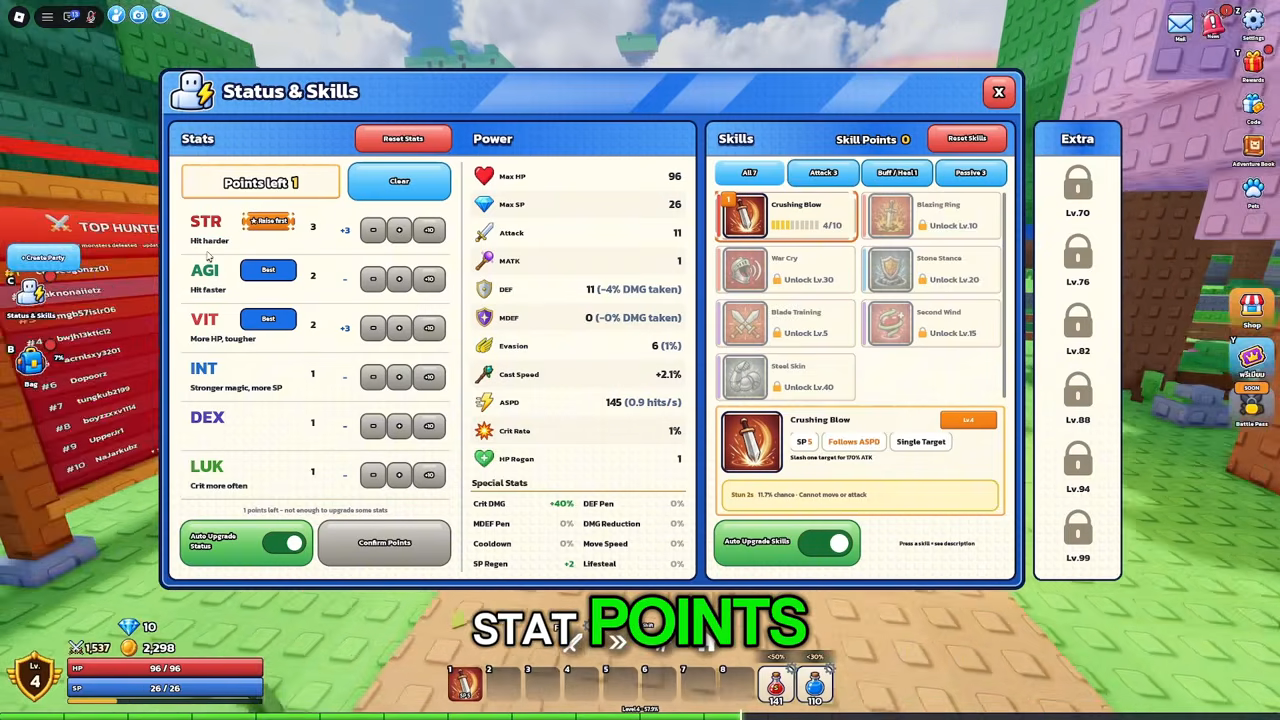
Stat priorities by class
Primary stat priorities by class
- Class
- Swordsman
- Combat role
- Melee tank with a one-handed sword, high HP and high defense
- Primary stat priorities
- STR and VIT
- Class
- Thief
- Combat role
- Fast melee attacker with rapid burst damage and high criticals
- Primary stat priorities
- STR, LUK and AGI
- Class
- Archer
- Combat role
- Long-range bow combatant with sustained single-target damage
- Primary stat priorities
- DEX, LUK and AGI
- Class
- Mage
- Combat role
- Long-range caster using fire, ice and lightning AoE spells
- Primary stat priorities
- INT and AGI
- Class
- Merchant
- Combat role
- Balanced melee fighter with ground smash attacks and gold bonuses
- Primary stat priorities
- STR, ASPD and survivability
- Class
- Cleric
- Combat role
- Group support through healing and the Second Down resurrection skill
- Primary stat priorities
- No stat priorities listed
The table lists stat priorities for five classes. The Cleric is documented by role instead: it works well in groups through healing and the Second Down resurrection skill, and no stat priorities are listed for it. If you play a Cleric, that group-support identity is the useful starting point that is actually documented.
Primary stats are only half of what a class is, though. The same class notes describe each class's baseline survival profile, and that profile shapes how far a stat priority can lean toward damage. The Swordsman has the highest baseline defense, allowing beginners to withstand boss attacks directly, which fits a frontline list of STR and VIT. The Thief and Archer deal high damage from the start but have low baseline health, so their play calls for dodging monster attacks; both list AGI among their priorities. The Mage stays at long range with fire, ice and lightning AoE spells, and its list is INT and AGI. The Merchant is the balanced melee option with ground smash attacks and gold bonuses, running STR alongside ASPD and survivability, and it accelerates currency gain during standard farming loops, which pairs well with gold farming.
Gearing around your main stat
Choosing a stat priority is only the first half of a build. The other half is whether your equipment feeds those stats and whether you can actually equip it. In one account from shortly before a dungeon update, a player said he needed to wear main stat gear but was not yet level 99, and planned to fix that before entering the dungeon. The practical point is that main-stat gear can carry a level requirement, so check that you meet it before planning around a piece. A perfectly stated item does nothing for the build while its requirement keeps it off your character, and the class leveling page covers the level side of that gap.
The same session shows how to judge a drop when it appears. He showed an item with notable ATK stats, said that if it were orange it would be absolutely perfect, and noted that he had not rerolled its stats at all. Two things follow: stat quality has a color indicator, with orange being the color he described as perfect, and items can be rerolled. When a drop already has the stats you want, there is nothing to fix; when it does not, a reroll is the lever you have. That makes color worth reading before you commit materials or currency to a piece.
Bonuses are worth re-checking after an update. Right after equipping a crafted piece, the same player questioned whether the game had just updated so that it no longer worked as he expected, saying the HP boost he had mentioned before was not good. He was reacting live, so treat it as his suspicion rather than a rule. The useful habit is still clear: a bonus you remember from an earlier version is not a guarantee, and if a build suddenly feels weaker than it did, a recent update is one explanation worth considering.
Keeping the build consistent when your role changes
Roles change for two reasons: you change what you want to play, or a group needs something different. Both put pressure on a build, and the documented examples point to one answer — build for transfer where you can, and keep a spare set where you cannot.
The clearest case is the physical versus magic split. A player who had been playing a magic build all along said he thought building physical was more worthwhile because in the end you play a crit build. He added that rings can all be used for crit builds and that the same ring can be used for all physical classes, so he decided to make gear for the rogue instead. The transferability is the useful part: a ring that fits a crit-oriented physical build is not stuck to one physical class, so the investment still counts if you move between them. That was his stated opinion during a crafting session before a dungeon update, not a measured verdict that physical always beats magic, but it explains why physical gear is the easier set to share.
He hedged in the other direction too, making several sets because he did not know what role he would be playing the next day, or whether there would be a party to join. If your own role is unsettled, a spare set is the buffer; if it is settled, one focused set is easier to finish. The equipment guide and equipment tiers are where to check what you are building toward.
Party demand is the other role signal. A day before the dungeon update, the same player expected a group to need a priest, a tank to pull monsters and a carry. That was a prediction, not something confirmed by play, but it makes the point that a build's usefulness can depend on the party slot it fills, not only on damage. The party guide covers that side of the decision.
Changing your stats is a separate decision from changing your gear. When he considered building as support, the player said he might have to reset his stats. What is documented is only that reset as an option — no procedure for it is shown — so treat it as the fallback to look into when a role change genuinely needs different stats, rather than a routine step in a build plan. If the change you want is a different class rather than a different role, the how to change class page is the starting point.
What gear work actually changes
The support damage figures are the clearest illustration that stats and gear are not only a damage-dealer concern. On his support character, the player reported damage going from roughly 7,000–8,000 before to 20,000, and 58,000 with buffs. Those are live spoken numbers from one session, not a stated formula, so they are not a guaranteed multiplier — but they show the scale a gear change can produce on a character whose job is support. He also framed it plainly: as a support, expecting it to hit hard from the outset is unrealistic, yet it was hitting a lot harder after the work. A support build still benefits from gear that matches its function.
Keeping the two questions together
Stat priority and build consistency answer each other. Your class's listed stats decide what your gear should carry; the gearing rules decide how that build survives a change of role — main-stat gear you can equip, stat color and rerolls when a drop misses, rings that carry across physical classes, and a spare set when your next role is uncertain. Keep the stat focus fixed and let the gear around it flex, and a build stays coherent even when the party around it does not.
Related Guides
Best Class for Every Playstyle
Compare every base class by how it handles solo leveling, boss hunts, Gold farming and healing, with the stats behind each pick.
Gear Types and Judging Drops
Compare weapons, armor, rings, cards and skins, and learn to read ATK, stat color and main stat before equipping a drop.
Skills, Passives and Extra
Review documented class abilities and combat roles, plus how the level 99 Extra system turns maxed classes into six equippable passives.