Hunting Together RPG Monsters Guide: Where to Hunt Each Monster
Find specific monsters by level band: rabbits and low-level beasts in the Level 1–8 starting forest, boars and lizards at 9–16, the Gorilla King boss gate at 25, elemental maps into the desert city, and Pumpkin Spiders roaming every zone during Halloween.
Quick answer
Hunt by level band. Hunting Together RPG places its monsters on floating sky islands, and progression runs through level-tiered zones separated by gatekeeper bosses, so the zone that holds your target is decided by the level range attached to it.
- Level 1–8 starting forest: rabbits and low-level beasts
- Level 9–16 wilderness zone: boars and lizards
- Level 25 boss gate: the Gorilla King guards the way into the first major town
Monster zones by level band
Data table
- Level band
- 1–8
- Zone
- Starting forest
- Monsters to expect
- Rabbits and low-level beasts
- Level band
- 9–16
- Zone
- Second wilderness zone
- Monsters to expect
- Boars and lizards
- Level band
- 17–24
- Zone
- Transition zone
- Monsters to expect
- Leads toward the first major town
- Level band
- 25
- Zone
- Boss gate
- Monsters to expect
- Gorilla King — defeat it to enter the town and its surrounding fields
- Level band
- 34, 42, 50+
- Zone
- Intermediate elemental maps
- Monsters to expect
- Lead into the desert city, where monster affinities change
- Level band
- Halloween event
- Zone
- Every zone
- Monsters to expect
- Pumpkin Spiders
The named creatures are the concrete part of the list: they tell you which zone to travel to for a specific monster, not just which level you should be. The bands come from the October edition of the beginner and progression guide, so they describe the intended route through the game rather than every optional corner of it.
Reading the zone list
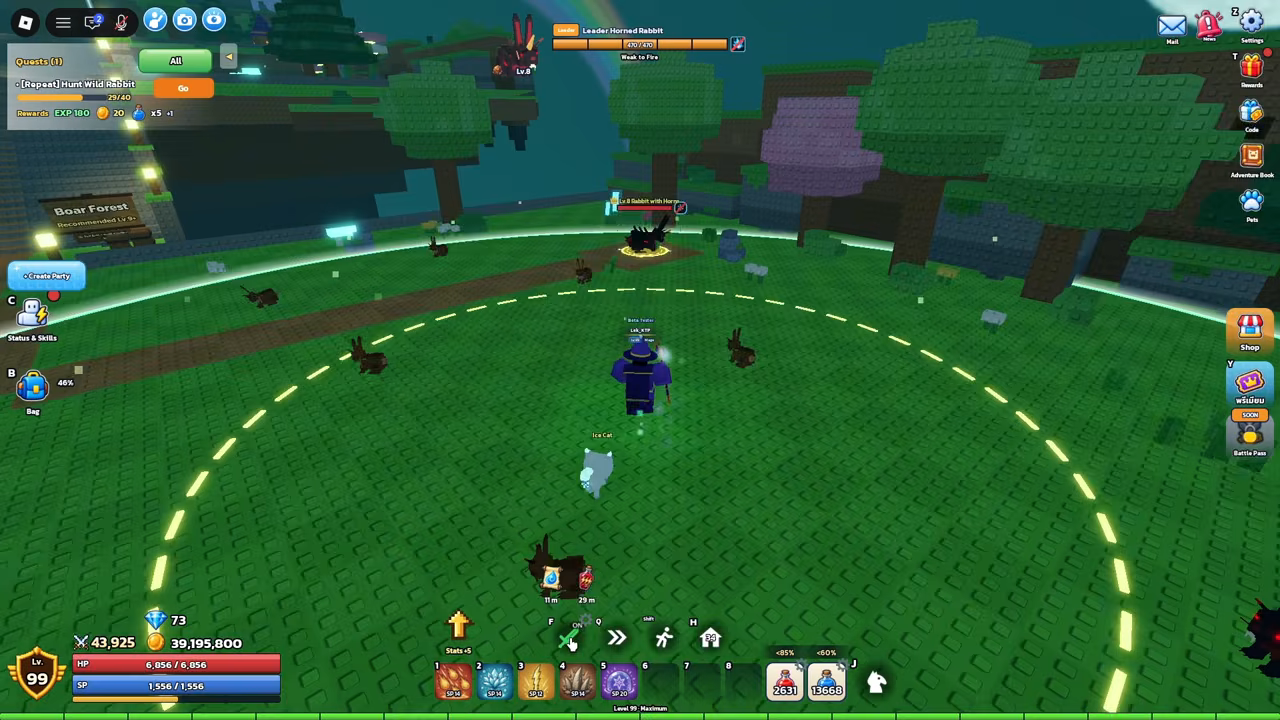
Level 1–8 — starting forest. Your adventure begins from a cozy sky-island village, and the first hunting band is the starting forest with rabbits and low-level beasts. If the creature you are chasing is one of those early forest animals, this band is where you will find it, and the forest is also the place to confirm you have the right level before pushing further.
Level 9–16 — second wilderness zone. The second band moves to a different wilderness area featuring boars and lizards. The change of creatures is the useful signal here: when the wildlife shifts from forest animals to boars and lizards, you know you have crossed into the next band rather than wandered into an interchangeable stretch of map.
Level 17–24 — transition zone. This band is described as a transition leading toward the first major town, which places it directly before the Level 25 boss gate. There is no separate headline creature attached to it in the guide, so treat it as the approach to the gate and to the town beyond rather than as a destination for one particular monster.
Level 25 — the Gorilla King gate. The Gorilla King blocks progress into the next territory. Defeating it clears the gate to enter the town and its surrounding fields. That makes the Gorilla King a prerequisite rather than an optional detour: if the monster you want lives past the town, you have to get through this fight first, and the fields around the town become your hunting ground once you do.
Level 34, 42 and 50+ — elemental maps into the desert city. Beyond the town, the guide lists Level 34, Level 42 and Level 50+ maps as intermediate elemental areas leading into the desert city, where monster affinities change. The affinity change is worth treating as a marker: the desert city is not simply a continuation of the forest and wilderness roster, so the matchups you learned in the early bands are not a safe assumption for what you meet there.
Gatekeeper bosses and the party shortcut
Zones are not connected by walking alone. The guide describes progression as advancing through level-tiered zones separated by gatekeeper bosses, with the Gorilla King as the named example at Level 25. Each gate is a deliberate pause: you reach it, you cannot pass, and beating the boss opens the territory behind it — for the Gorilla King, the town and its surrounding fields.
Bosses can be taken down with a party, and party EXP is shared at any level gap. That combination matters most at a gate you cannot clear alone. You do not need a group of exact-level peers to attempt a gatekeeper boss; a higher-level friend can join the fight, and the game's shared-EXP rule still applies to the party. If the boss itself is the problem, the bosses guide and the party guide cover those fights and group play in more depth.
The wider world beyond the level list
The official game listing describes the setting more broadly: you explore forests, deserts, snowfields and a volcano full of monsters and bosses, starting from a cozy sky-island village. That description is the landscape the level bands run through. When you have a specific creature in mind, the level bands are the sharper tool because they are the part of the material that assigns named monsters to places; the biome list tells you what kind of world those places belong to.
So the two descriptions answer different questions. "Where do I hunt this monster?" is a level-band question. "What does the world look like and where does my adventure begin?" is the broader listing question, and it starts at the sky-island village.
Pumpkin Spiders and the Halloween hunt
Pumpkin Spiders break the pattern of the level ladder. During the Halloween event they roam every zone, so you do not need to travel to a particular band to look for them — any hunting area can have them. They can also be fought by opening the Halloween Hard Worker Box, which gives you a second way to meet one besides finding it in a zone.
The rest of the event gives those spiders a context. The Halloween update adds a spooky village, Halloween Candy drops that you bring to the witch houses for Trick or Treat, and Pumpkin Heads that you collect to spin the Halloween Gacha for weapon skins. New Warp Pillars let players travel fast, which helps when you are moving between zones to hunt event monsters rather than grinding one band. The Halloween event page collects the event content in one place.
What the hunt gives you
Defeated monsters can yield monster cards, which players slot into their gear. That is the long-term reason to hunt a specific creature rather than whatever is closest: a card is a possible result of the kill, not a guaranteed one, so a target worth hunting is usually a monster you are willing to fight repeatedly. The monster cards guide covers what to do with a card once it drops, and the monster drops page covers loot more generally.
Hunting Together RPG also lists an Auto-hunt feature for hunting monsters. If you are planning to farm a zone for cards or levels, the auto battle guide is the place to look at how that feature is set up before you park yourself in one band for a long session.
Choosing your next hunting ground
- Check your level band first, then match it to the zone in the table above. The band decides where the game expects you to be hunting.
- Look for the named creature as confirmation. Rabbits and low-level beasts mean the starting forest; boars and lizards mean the second wilderness zone.
- If your level has passed the transition zone, the Gorilla King is the next target — beating it opens the town and its fields, and your hunting ground moves with it.
- Past the town, head for the Level 34, Level 42 and Level 50+ elemental maps that lead into the desert city, where affinities change.
- During the Halloween event, remember that Pumpkin Spiders can appear in every zone, so you can hunt them alongside whatever band you are already working through.
- If a gate boss is the only thing in your way, bring a party: bosses can be fought together and EXP is shared at any level gap.
If you are still deciding how to spend the early levels, the beginner guide and the progression guide put these bands in order, while the locations guide covers the places themselves. Once your character is built around a target, companion and stat planning matters less than simply being in the right band — the zone list is the part that answers where a specific monster lives.
Related Guides
Choose Auto Battle Targets
Uncheck unwanted monsters in the current area's target list, adjust range and movement, then hunt only the targets you chose.
Main Areas and Travel
Explore the floating sky islands, learn how level-tiered zones and gatekeeper bosses move you onward, and find faster travel options.
Monster Drops and Loot Control
See what monsters drop, what each item is for, and how Pickup Filters, targeting, range and pets keep the loot you want.
Repeatable Hunting Quests
Run the forty-monster zone elimination quests for leveling and learn how party members advance the same kill count.